
View full-size graphic
What is the AITD Capability Framework?
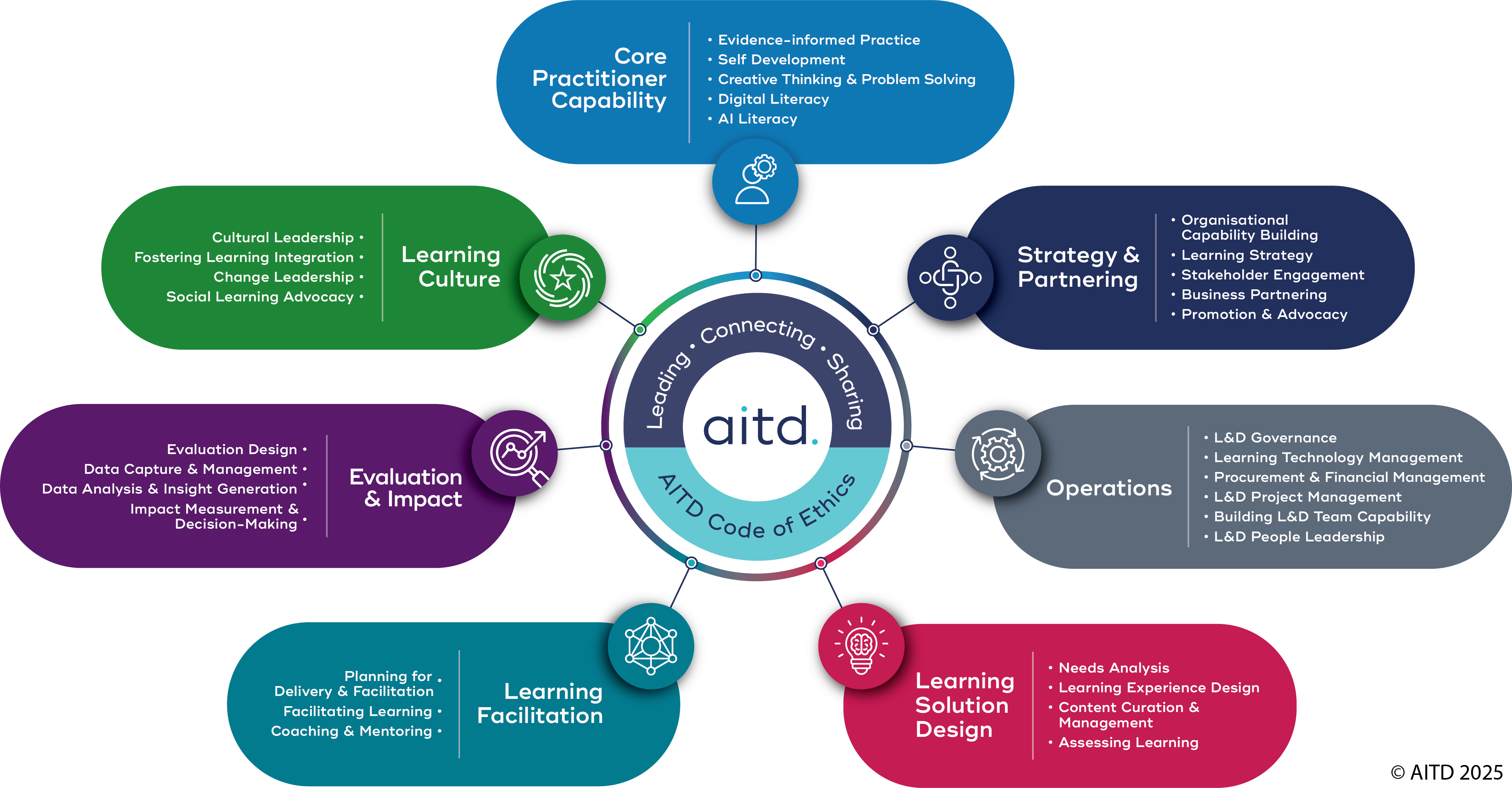
The AITD Capability Framework is Australia's learning and development capability framework: a description of the 31 capabilities that effective L&D professionals use, grouped into seven categories and described at three levels (Foundational, Intermediate and Advanced). It was built by more than 160 Australian L&D practitioners, tested across government, corporate, not-for-profit, consulting and education settings, and is maintained by the Australian Institute of Training and Development (AITD), the peak body for L&D professionals in Australia.
Use it to assess your own capability, set career objectives and build a development plan. Teams use it to map collective strengths and gaps and to hold development conversations in a shared language.
Key facts
- 31 capabilities in seven categories, each described as observable behaviours at three proficiency levels
- Built by L&D practitioners for L&D practitioners: 30 working group members, 30 focus group leaders and 100 user testers
- Applies to internal L&D teams, consultants and suppliers, in any sector
- Grounded in the AITD Code of Ethics and Professional Practice and AITD's values of Leading, Connecting and Sharing
- Available to AITD members through an online self-assessment, with a resource library and courses mapped to each capability
“All of the elements in there really resonated with me - the capabilities were articulated really well.” Julie Hemington, Senior Learning Architect
The seven capability categories
Every capability in the framework sits in one of these categories. Together they describe the full span of learning and development work, from the fundamentals every practitioner needs to the strategic and cultural work of L&D leaders.

Core Practitioner Capability is the set of skills every L&D professional needs, whatever their role: evidence-informed practice, digital literacy and AI literacy among them.

Strategy and Partnering is building the relationships that align learning with business goals and position L&D as a trusted adviser to the organisation.

Operations is managing the L&D function's resources, systems and projects, and developing a high-performing L&D team.

Learning Solution Design is designing, developing and curating engaging, inclusive learning experiences that improve performance.

Learning Facilitation is facilitating effective learning across face-to-face, virtual and blended environments, using a range of tools, techniques and delivery modes.

Evaluation and Impact is evaluating and improving learning initiatives using data, analytics and evidence of impact.

Learning Culture is championing and embedding the practices that make continuous learning part of how the whole organisation works.
Each category is a set of specific capabilities, and each capability is described at Foundational, Intermediate and Advanced level as behaviours you can observe. AITD members see the full list, with the behavioural indicators for every level, in the capability assessment.
How to use the framework: three steps

Step 1: Self-assess
Rate yourself against the behavioural indicators for each of the 31 capabilities to see where you stand, and where your strengths and gaps are.
Step 2: Set career objectives
Compare your profile with the capability profile of the roles you are aiming for, and decide where development will make the most difference.
Step 3: Create a development plan
Choose from learning activities mapped to each capability, from free resources to AITD courses, webinars and journal articles, build your plan and track your progress over time. Your progress can also be recorded in your AITD Continuing Professional Development (CPD) record.
"This framework is a huge value add... it helps L&D leaders have development conversations with their people that align with business strategy." Emily Black, Learning and Organisational Development Manager
Who the framework is for
Starting out in L&D
If you are new to learning and development, the framework shows you the capabilities the profession and employers value most, so you can build the foundations first instead of learning by trial and error.
Planning your next move
Whether you are aiming for a team leadership role, want to specialise, or are considering consulting, the framework points you to the capabilities that match your goal. It is a practical, peer-built roadmap of what L&D leaders look for.
Building your professional standing
The capabilities are recognised across sectors, so an assessment and a development plan against the framework give you a credible way to show employers, clients and peers how you have grown.
Staying relevant
The framework is reviewed and refined regularly, so it keeps pace with changes such as AI in learning and shifting employer expectations, and helps you focus on the capabilities that matter next.
Leading a team
Teams that are AITD corporate members get a dashboard with aggregate reporting across all 31 capabilities. Leaders use it to see the team's collective profile, plan workforce capability against current and future roles, and hold development conversations grounded in a shared standard. The team tools scale from a group of two to two hundred. Contact AITD about corporate membership and team reporting.
How the framework was built
Co-created by the L&D community. Starting from AITD's own research, more than thirty L&D professionals formed seven working groups, one for each capability category, and drafted the capabilities by mapping their practice against established models and theories. An editorial team then worked for consistency, coherence and alignment with the ten design principles below.
Working group members
- Project Sponsor: Ben Campbell
- Project Lead: Michelle Ockers
- Project Editor: Lisa Elias
- Project Test and Validation Lead: Neil Coulson
- Amanda Ashby
- Joseph Atkinson
- Shai Desai
- Kate Fraser
- Jemai Duque Gomez
- Beth Hall
- Sally Hawse
- Marilyn Hubner
- Richa Jain
- Angela King
- Millie Law
- Catriona Malcolm
- Isabel Malferrari
- Carly Middap
- Andrew Napier
- Samantha Noonan
- Jane Phillips
- Jane Richardson
- Nick Rouen
- Lee Roulston
- Megan Silenge
- Merinda Smith
- Kate Smyth
- Belinda Wetenhall
- Zoe Youl
- Liz Seskus
- Neil Von Heup
- Sophie Berner
- Michelle Graffeo
Validated across sectors. Thirty L&D leaders took part in focus groups for the corporate, government, not-for-profit and supplier sectors, confirming the framework's relevance in each and sharpening its language.
Tested by practitioners. One hundred L&D professionals of different sectors, roles and experience levels completed self-assessments and gave detailed feedback, which shaped the final version. The result is a living document that supports conversation, learning pathways and capability development for most sectors, roles and career stages.
“I can see this framework becoming a go-to blueprint for practitioners navigating the complex world of workforce L&D.” Kade Brown, RMIT Online
The ten design principles
The framework is built on ten design principles. Click to expand.
| Principle | Description |
| Comprehensive | The framework covers all critical skills required in an L&D function and applies to both internal L&D professionals and external consultants and suppliers. |
| Flexible | The framework applies to L&D professionals across diverse organisational contexts and sectors, recognising that the relevance of specific capabilities varies across contexts. |
| Useful | Capabilities help L&D practitioners to perform their roles more effectively today. |
| Behavioural focus | Capabilities are expressed as observable behaviours. |
| Emergent | Capabilities equip L&D practitioners to adapt to the evolving needs of the profession (2-5 years). |
| Sustainable | Capabilities are expressed in a way that emphasises enduring knowledge and skills and does not rely on specific frameworks, models or tools. |
| Simple | The framework and capability descriptions are as simple and accessible as possible, while still capturing the complexity of the work. |
| Unique | Capabilities are distinct and non-overlapping. |
| Unambiguous | Language is clear and concise. |
| Ethics and values | Capabilities are underpinned by the standards of professional conduct in the AITD Code of Ethics and Professional Practice, and reflect our values of Leading, Connecting and Sharing. |
These principles keep the framework practical and current, so it serves L&D professionals at every career stage and supports a team-based approach to capability development in organisations of any size.
Frequently asked questions
How many capabilities are in the AITD Capability Framework?
Thirty-one capabilities, grouped into seven categories: Core Practitioner Capability, Strategy and Partnering, Operations, Learning Solution Design, Learning Facilitation, Evaluation and Impact, and Learning Culture. Each is described at Foundational, Intermediate and Advanced level.
Who is the framework for?
Anyone who works in learning and development in Australia: in-house L&D teams, consultants, suppliers and educators, at any career stage and in any sector. It was tested in corporate, government, not-for-profit and supplier settings.
How do I access the framework and the self-assessment?
The framework and its online self-assessment are an AITD member benefit. Members log in at aitd.com.au, open My Account and choose Capability Assessment. Non-members can join AITD to get access.
Is the framework a qualification?
No. It is a professional development tool, not a qualification or a certification. AITD is a not-for-profit professional body, not a registered training organisation, so the framework does not replace a formal qualification. It helps you show what you can do and plan what to develop next.
Does it connect to AITD courses?
Yes. Every AITD course page shows the capabilities it develops, and the resource library and development planner suggest courses, webinars and other resources for each capability.
Can my team use it?
Yes. Corporate members get team dashboards that aggregate the assessments of a group of any size, for workforce planning and development conversations.
Get started
Current AITD members
- Log in to the AITD website at aitd.com.au
- Open My Account in the top menu
- Choose Capability Assessment in the Welcome menu
- Accept the platform terms on your first visit
- Start your self-assessment
AITD members can also use the Capability Framework Resource Library, a growing collection of articles, guides, podcasts and websites organised by capability, alongside their assessment.
Not yet a member?
The framework is a member benefit, developed and kept current by AITD members for the profession. Join to assess yourself, build a development plan and use the resource library.

"I think I'd probably say 95% of [the capabilities] are really relevant to our teams... my first impression was it's got a lot of value to offer and covers lots of ground." Janine Davidson, L&D Leader, Technical Training
Support
- Companion guide: download the guide to completing your assessment and development plan.
- Technical support, questions and feedback: use the contact form and select Capability Assessment query.
About the assessment platform
AITD thanks Lexonis for partnering with AITD on this initiative. With 25 years of experience in competency-based solutions, including SFIA (Skills Framework for the Information Age), Lexonis provides the software and expert guidance behind the capability assessment and team reporting.